Imagine changing your mobile network provider without changing your phone number.
You simply choose another operator, complete the required process and continue using the same number.
India’s FASTag system is now moving towards a similar idea.
On September 11, 2026, Union Minister for Road Transport and Highways Nitin Gadkari launched OneTag, a new FASTag portability system that allows users to change the bank associated with their FASTag without replacing the physical tag fixed to their vehicle.
That may sound like a small change.
For people who use FASTag occasionally, it may simply mean less paperwork and fewer calls to customer care.
But for transporters and fleet operators managing multiple trucks, it could be much more useful.
FASTag is already a core part of India’s road-freight system. Now, the system is becoming more flexible.
And this raises an interesting question:
Is FASTag finally becoming portable in the same way that mobile numbers became portable?
The short answer is yes, in terms of switching the service provider — but not in terms of moving the tag from one vehicle to another.
Understanding that difference is important.
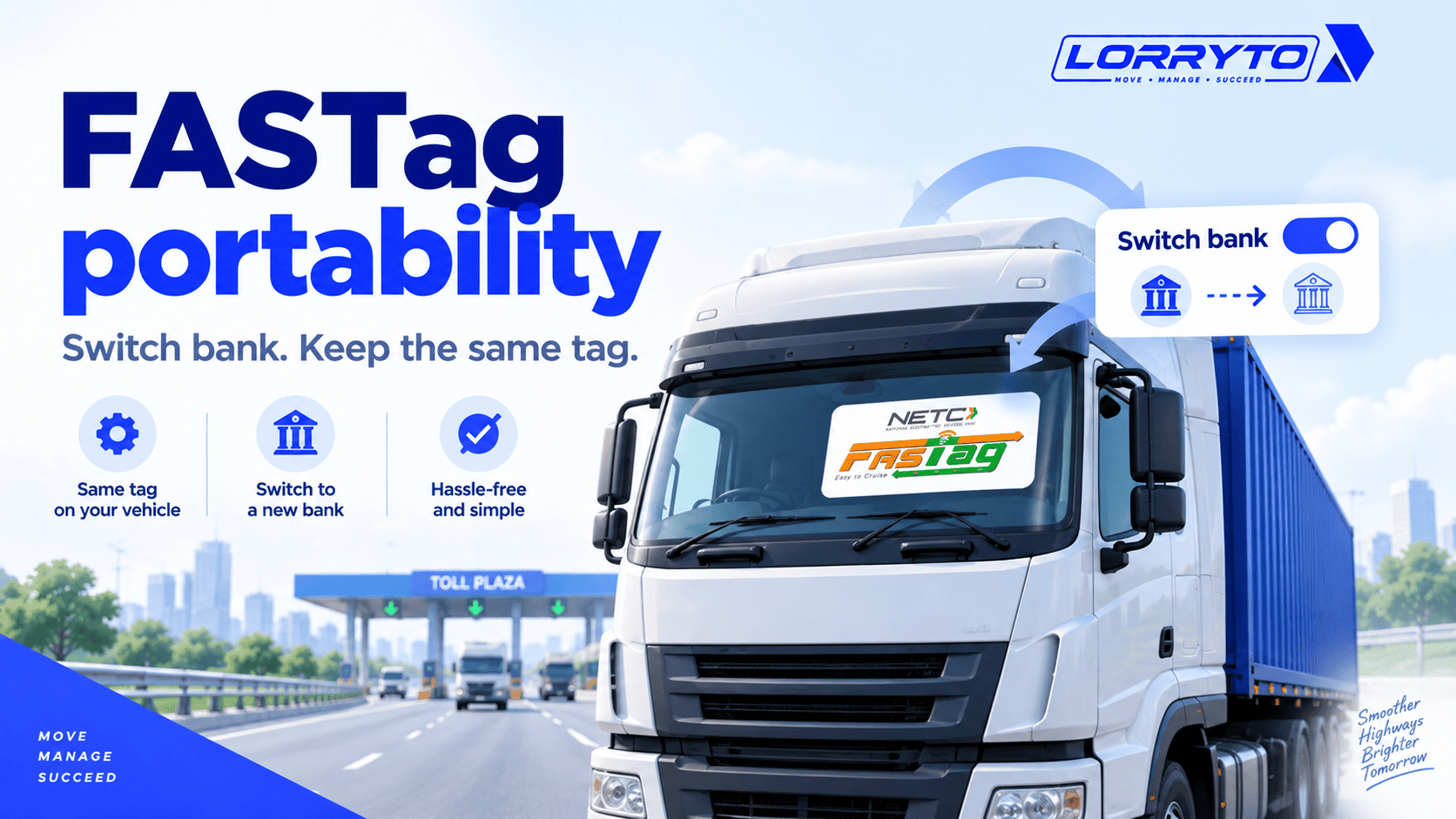
What has changed with FASTag?
Until now, changing the bank associated with a FASTag was not a simple process.
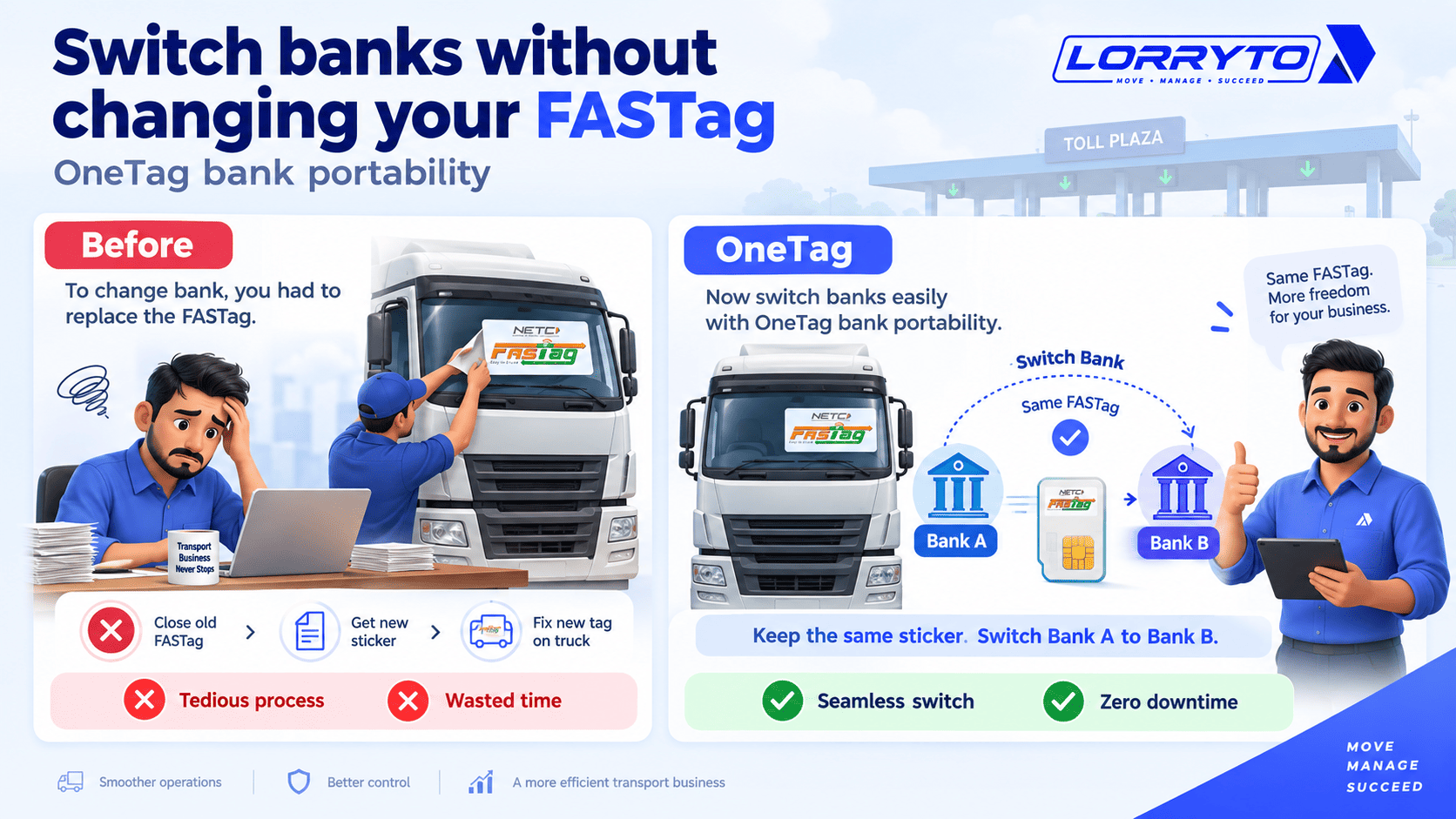
If a vehicle owner was unhappy with the service provided by one bank and wanted to move to another, the usual process involved closing the existing FASTag and obtaining a new one.
The new tag then had to be issued and fixed to the vehicle.
This was inconvenient, particularly for commercial vehicles that are constantly on the road.
The existing FASTag itself is linked to the vehicle. NPCI describes FASTag as a vehicle-specific RFID tag that is affixed to the windscreen, with toll payments deducted from the linked account. It cannot simply be transferred from one vehicle to another.
The new OneTag system changes one important part of this process.
The physical FASTag can stay on the vehicle while the customer changes the bank associated with it.
In simple terms:
Earlier:
Bank A → Close FASTag → Get new FASTag → Fix new tag → Start using Bank B
With OneTag:
Bank A → Choose Bank B → Complete portability process → Keep the same FASTag
That is the real change.
Why is it being compared with mobile SIM portability?
The comparison with mobile SIM cards is easy to understand.
When mobile number portability became common in India, users no longer had to give up their phone number simply because they wanted to change telecom operators.
The number stayed the same.
The service provider changed.
OneTag follows a similar principle for FASTag.
The vehicle continues to use the same FASTag, while the bank providing the FASTag service can change.
According to current reports on the OneTag launch, the FASTag’s Tag ID and the vehicle’s registration number remain unchanged during the portability process.
That gives users more freedom to choose their service provider.
However, there is an important difference.
FASTag is still vehicle-specific
You cannot take the FASTag from Truck A and put it on Truck B.
That remains against the FASTag rules.
NPCI’s current information states that a FASTag issued for one vehicle cannot be used on another vehicle. Using a tag on another vehicle can result in the tag being blacklisted.
So, when we say “FASTag is becoming portable,” we mean bank portability, not vehicle portability.
That distinction is important for every fleet owner to understand.
What exactly is OneTag?
OneTag is a FASTag portability solution developed around the NETC ecosystem.
Current reports say the system has been developed by Indian Highways Management Company Limited (IHMCL) and National Payments Corporation of India (NPCI), with IHMCL promoted by NHAI. It was launched at the Global Fintech Fest 2026.
The basic idea is simple.
A FASTag user who wants to change the issuing bank can use the portability process rather than getting another physical FASTag.
Reports on the launch indicate that the process will be available through the Rajmargyatra mobile app, with eligibility checks and verification before the user selects a new bank.
This is another step in moving FASTag from being simply a toll-payment sticker to becoming part of a more flexible digital highway-payment system.
Why does this matter for truckers?
For a private car owner, replacing a FASTag is mostly an inconvenience.
For a truck operator, it can become an operational problem.
A commercial truck may spend days or weeks travelling across different states.
It crosses multiple toll plazas.
Toll payments become a regular operating expense.
The FASTag account therefore needs to remain active, funded and properly linked to the vehicle.
If the operator has a problem with the issuing bank, changing the FASTag can mean additional administrative work.
The physical tag has to be replaced.
The new tag needs to be activated.
The old account has to be closed.
Balances and pending transactions need to be handled.
And someone in the office has to make sure that the truck continues to operate without disruption.
For a single vehicle, that may be manageable.
For a fleet of 20, 50 or 500 trucks, it becomes a much bigger administrative task.
This is where OneTag could make a difference.
Fleet operators have a different problem
Consider a transport company operating 100 trucks.
Each vehicle may have its own FASTag.
Each FASTag may have its own account, balance and transaction history.
The company may also have different banks for different financial services.
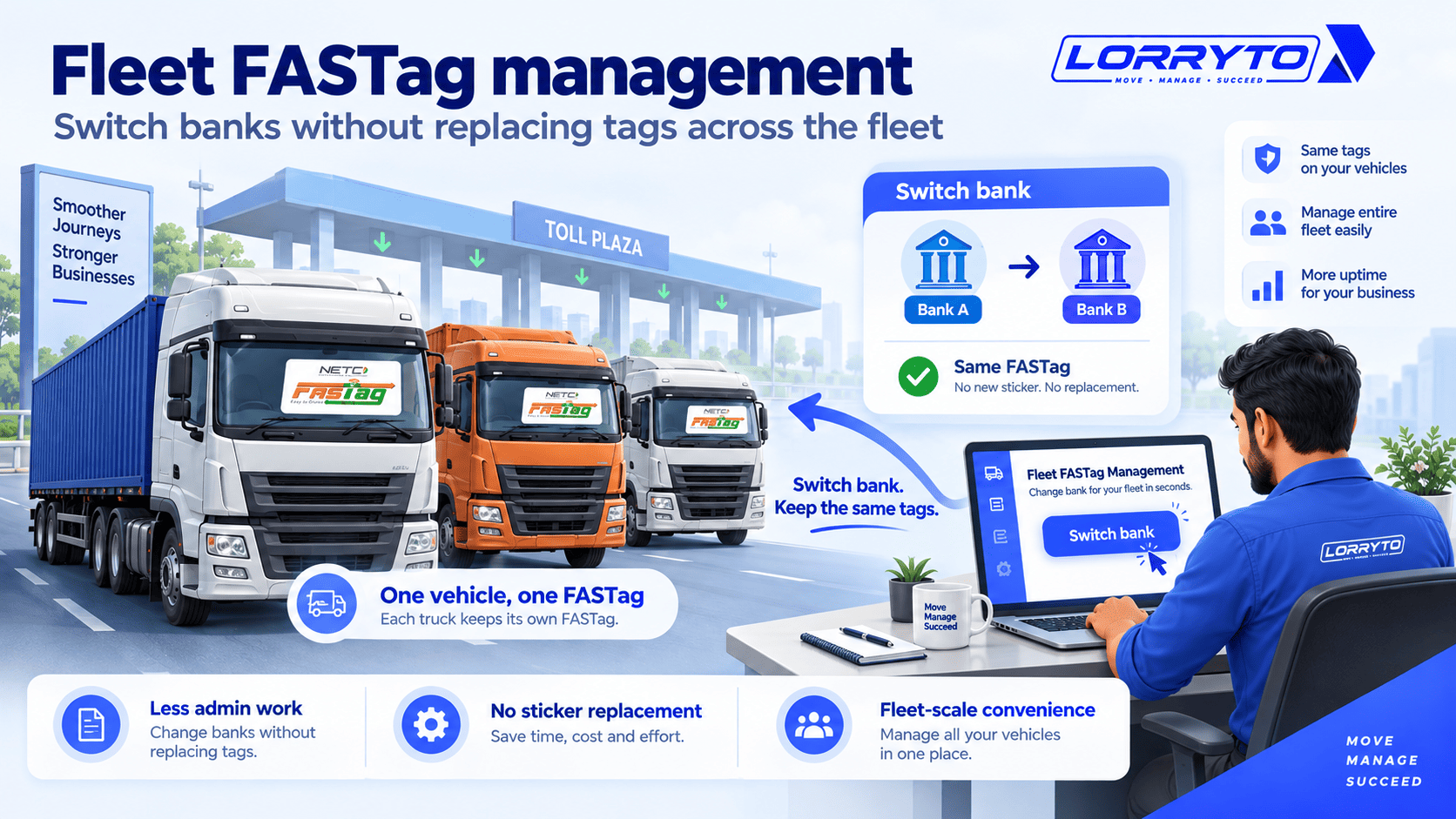
If the company wants to consolidate FASTag services with another bank, changing hundreds of physical FASTags would be a significant exercise.
With portability, the process becomes much simpler because the physical tag does not need to be replaced just because the bank changes.
That could reduce administrative work for fleet operators.
More importantly, it can make the FASTag ecosystem more competitive.
Banks will have to compete more on:
- Customer service
- Recharge experience
- Transaction reliability
- Dispute resolution
- Account management
- Fleet support
- Digital features
The customer does not have to feel locked into the existing bank simply because the physical FASTag is already attached to the truck.
OneTag could make FASTag more like a digital service
This may be the bigger story behind the announcement.
FASTag started as a relatively simple solution:
RFID tag + bank account + automatic toll deduction.
Over time, it has become a much larger digital ecosystem.
There are now systems for KYC, vehicle validation, transaction processing, toll reconciliation, local passes and other services.
The government has also been simplifying parts of the FASTag experience.
For example, NHAI discontinued routine Know Your Vehicle (KYV) requirements for new FASTags issued to cars, Jeeps and vans from February 1, 2026, while retaining KYV for specific cases involving complaints or misuse.
NHAI has also expanded online FASTag local passes to 121 toll plazas through the Rajmargyatra app.
OneTag fits into the same broader direction:
Make highway payments more digital, flexible and easier to manage.
The “One Vehicle, One FASTag” rule still matters
There is another important point that fleet operators should not miss.
OneTag does not mean that a vehicle can have multiple active FASTags.
India’s “One Vehicle, One FASTag” policy remains important.
NHAI introduced the initiative to discourage the use of multiple FASTags for a single vehicle and to improve the reliability of electronic toll collection. Earlier FASTags linked to the same vehicle were to be deactivated or blacklisted, leaving only the latest valid tag active.
This means fleet owners should not interpret portability as permission to keep multiple tags active.
The principle remains:
One vehicle → One active FASTag
What changes is the ability to change the bank associated with that tag without replacing the physical sticker.
What happens to the old bank?
This is an important operational question.
Changing banks does not simply erase everything associated with the old account.
According to current reporting on OneTag, the old bank will continue to handle matters connected to the old wallet, including things such as balance, refunds and pending transactions. The new bank takes responsibility for the FASTag services after the portability process is completed.
This separation matters because FASTag is not only a physical RFID sticker.
There is a financial account and transaction history behind it.
The portability system therefore needs to change the service relationship without creating confusion about old balances or pending transactions.
That is one of the reasons the change is more significant than simply “changing the bank name.”
What does this mean for toll expense management?
For transport companies, toll is a regular operating cost.
A long-distance truck can cross multiple toll plazas during a single trip.
Over hundreds or thousands of trips, these payments add up.
This makes toll data useful for fleet managers.
A transporter may want to know:
- How much toll did each truck pay?
- Which trips had the highest toll cost?
- How much did a particular route cost?
- Was the toll expense included in the trip calculation?
- How does toll cost affect trip profitability?
- Are there unusual or duplicate transactions?
- How much is the fleet spending on tolls every month?
As FASTag becomes more integrated into digital transport operations, this data can become increasingly useful — especially when trip costs are already tracked digitally, as we covered in vehicle expense automation and digital trip tracking.
FASTag is becoming part of fleet data
The interesting thing about FASTag is that it is not only a payment technology.
Every toll transaction creates operational information.
A toll transaction can tell a business that:
A particular vehicle passed a particular toll point at a particular time.
When this information is combined with trip records, GPS data, fuel expenses and other operational information, it can give fleet managers a better picture of how a vehicle is performing.
This is where digital fleet-management systems become relevant.
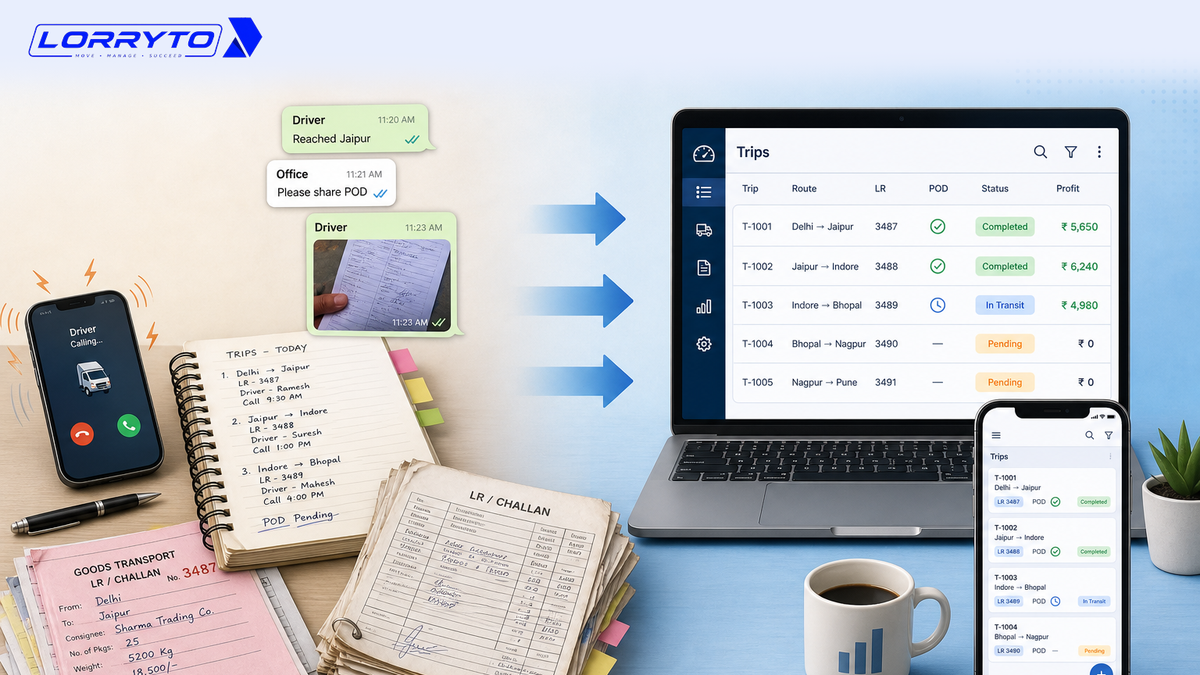
For example, platforms such as Lorryto help transport businesses track vehicle locations when drivers share GPS and manage trip and vehicle-level revenue and expenses on the Vehicles list. As FASTag and other highway systems become increasingly digital, combining operational and financial information can give transporters a clearer picture of the real cost and performance of each trip.
The important point is not that FASTag replaces fleet management.
It is that FASTag creates another valuable stream of information that can eventually be used alongside fleet data.
Could FASTag portability help large fleets more than individual users?
Probably.
For an individual vehicle owner, OneTag is mainly about convenience.
For a fleet operator, it can also be about scale.
Imagine a company managing 300 trucks.
If it changes its banking relationship, it does not want its operations team to manage hundreds of physical FASTag replacements.
Even a small amount of administrative work per vehicle becomes significant when multiplied across a large fleet.
Portability can reduce that burden.
It can also make fleet-level bank selection easier.
A company may choose a bank based on its corporate banking relationship, customer service, reconciliation capabilities or digital tools without having to replace every physical FASTag on the fleet.
Does OneTag mean FASTag can be moved to another truck?
No.
This is probably the most important clarification to make.
OneTag does not make FASTag transferable between vehicles.
If a FASTag is issued for Truck A, it cannot simply be removed and used on Truck B.
FASTag remains linked to the specific vehicle and its registration details. NPCI explicitly states that FASTag is vehicle-specific and cannot be transferred to another vehicle.
So the comparison is:
Mobile number portability
Same number → Different telecom operator
FASTag portability
Same FASTag → Different issuing bank
But:
Not
Same FASTag → Different vehicle
That remains prohibited.
What could change for transport businesses?
OneTag is a small change on the surface, but it could have a wider impact on the way commercial vehicles manage toll payments.
It can make the FASTag ecosystem more competitive.
It can reduce physical tag replacement.
It can simplify bank switching.
It can reduce some administrative work.
And it can make digital toll services more user-friendly.
For fleet operators, the biggest benefit may simply be less friction.
The truck can keep moving while the financial service behind the FASTag changes.
That matters in an industry where every hour of unnecessary downtime has a cost — the same theme that shows up when logistics networks get more connected through freight corridors and electric corridor deployments.
The bigger shift: from toll collection to intelligent highway payments
There is an even larger transformation happening alongside OneTag.
India is moving towards increasingly automated toll collection.
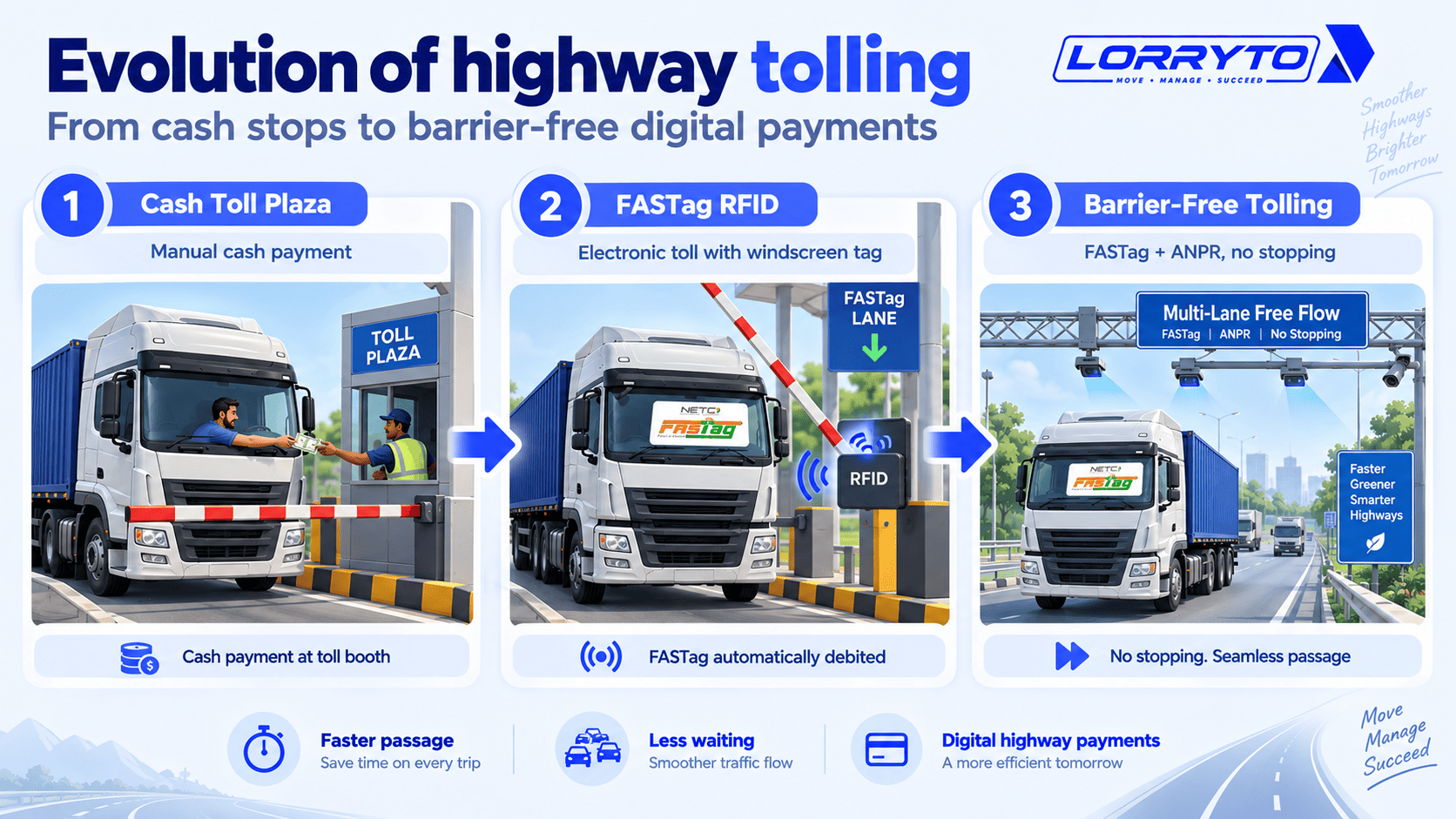
On September 11, 2026, Gadkari also outlined plans for a barrier-free digital tolling system by around February–March 2027, combining FASTag with number-plate recognition so that vehicles can pass toll points without stopping at conventional barriers. He said FASTag penetration at National Highway toll plazas has already crossed 98%, with more than 13 crore tags issued.
If that transition happens as planned, the toll plaza itself could gradually become less visible to the driver.
Today:
Vehicle → Toll Plaza → FASTag Scan → Payment → Barrier Opens
The longer-term model could become:
Vehicle → Automatic Identification → Automatic Toll Calculation → Digital Payment
That is a significant change.
The highway becomes more like a digital network.
What does this mean for the future of trucking?
For truckers, the important point is that several systems are becoming connected.
GPS tells the business where the truck is.
FASTag records toll transactions.
Fleet-management software tracks trips and expenses.
Digital documents handle compliance and freight information.
Electronic tolling reduces the need for physical cash.
These systems are gradually creating a more connected transportation ecosystem.
The future truck will not simply be a vehicle moving from Point A to Point B.
It will be a connected asset generating operational and financial information throughout the journey.
That is where the real value of these digital systems lies.
What should fleet owners do now?
For transporters, there is no need to overcomplicate the change.
A few basic steps are useful.
Check your current FASTags
Make sure every vehicle has the correct FASTag linked to the correct registration number.
Follow the One Vehicle, One FASTag rule
Avoid keeping multiple active tags on the same truck.
Monitor FASTag balances
A truck should not get delayed because its toll wallet does not have sufficient balance.
Keep bank and vehicle records organised
The FASTag, vehicle number, bank account and internal fleet records should match.
Watch for OneTag availability
If you want to change the issuing bank, check the latest OneTag process and eligibility through the official channels as the service is rolled out.
Connect toll data with trip economics
Toll is a real operating cost. It should be considered when calculating the profitability of a route or trip.
A small change with a bigger meaning
At first glance, OneTag may look like a simple customer-convenience feature.
And for many users, that is exactly what it will be.
But the larger story is about how India’s road infrastructure is becoming more digital.
FASTag has already changed the way tolls are collected.
Now portability is changing the relationship between the user, the FASTag and the issuing bank.
The next step could be even more seamless tolling, with FASTag working alongside vehicle number-plate recognition and other technologies to reduce or eventually remove the need to stop at toll barriers.
For India’s transport industry, these changes matter because small operational improvements can have a large impact when multiplied across millions of trips.
A truck does not need to stop for a few minutes at every toll plaza.
A fleet manager does not need to replace hundreds of FASTags simply because the company changes banks.
A transporter can increasingly manage toll payments as part of a wider digital operation.
The road ahead
The comparison with mobile SIM portability is useful because it explains the idea in simple terms.
Keep the same FASTag. Change the bank.
But the bigger message is that FASTag is becoming more flexible without losing its connection to the vehicle.
That is important.
The tag stays with the vehicle.
The bank can change.
And the digital system handles the relationship in the background.
For individual vehicle owners, this means convenience.
For truckers, it can mean less administrative work.
For fleet operators, it can mean easier management at scale.
And for India’s wider transportation industry, it is another step towards a road network where toll collection, vehicle identification, payments and fleet operations increasingly work together.
The FASTag sticker on a truck’s windscreen may not look very different tomorrow.
But the system behind it is becoming much smarter.
The next phase of FASTag is not just about paying tolls.
It is about making the entire highway payment experience more portable, digital and connected.
If you are still building the trip and expense visibility that toll costs belong in — getting started with Lorryto is a practical place to begin.
Related reading
- India’s Freight Rail Network Is Changing Road Transport: What the Dedicated Freight Corridors Mean for Truckers
- Electric Trucks Are Leaving the Pilot Stage: Is India Ready for Electric Freight Corridors?
- How to Manage Every Trip Tracking Digitally for Indian Transporters
- How to Automate Your Transport Office: Vehicle Expenses
- Vehicles list — location, KPIs, and fleet visibility
Ready to run trips without registers?
Create LRs, track payments, and keep documents in one place with Lorryto — free trial available.
Start Free Now