For years, electric trucks in India were discussed as a technology for the future.
There were pilot projects, demonstrations and small-scale deployments, but the larger question remained: Can electric trucks work as a practical and profitable solution for India’s freight industry?
That conversation is now changing.
India’s electric freight sector is moving beyond individual pilot projects and towards larger, corridor-based deployments. In September 2026, NITI Aayog’s e-FAST India initiative launched the Platform for Aggregating Clean Transport (PACT) and the Zero Emission Truck (ZET) Marketplace to bring together shippers, logistics companies, vehicle manufacturers, financiers and charging operators.
The development comes as India’s electric freight market begins to scale. According to NITI Aayog / e-FAST reporting, e-freight vehicle deployments increased more than fourfold, from 201 vehicles in FY2025 to 826 in FY2026, while more than 3,000 electric medium- and heavy-duty trucks are now operating across the country.
At the same time, companies are preparing to deploy hundreds of electric heavy trucks on some of India’s busiest freight routes.
The shift is becoming clear:
Electric trucking is moving from the pilot stage towards real commercial operations.
But that raises an important question.
Is India ready for electric freight corridors?
The electric truck conversation is changing
The early discussion around electric trucks focused mainly on the vehicle.
How far can it travel?
How long does it take to charge?
How much does the battery cost?
Can it carry a heavy load?
These questions still matter. But for a transporter, they are only part of the picture.
A truck is not an isolated asset. It is part of a larger business operation.
It needs to complete trips on time, carry the required load, maintain high utilisation and generate enough revenue to justify its operating cost.
That means the more important question is no longer simply:
“Can an electric truck travel long distances?”
It is:
“Can an entire freight operation built around electric trucks work reliably and profitably?”
That is where freight corridors become important.
India is starting to think in freight corridors
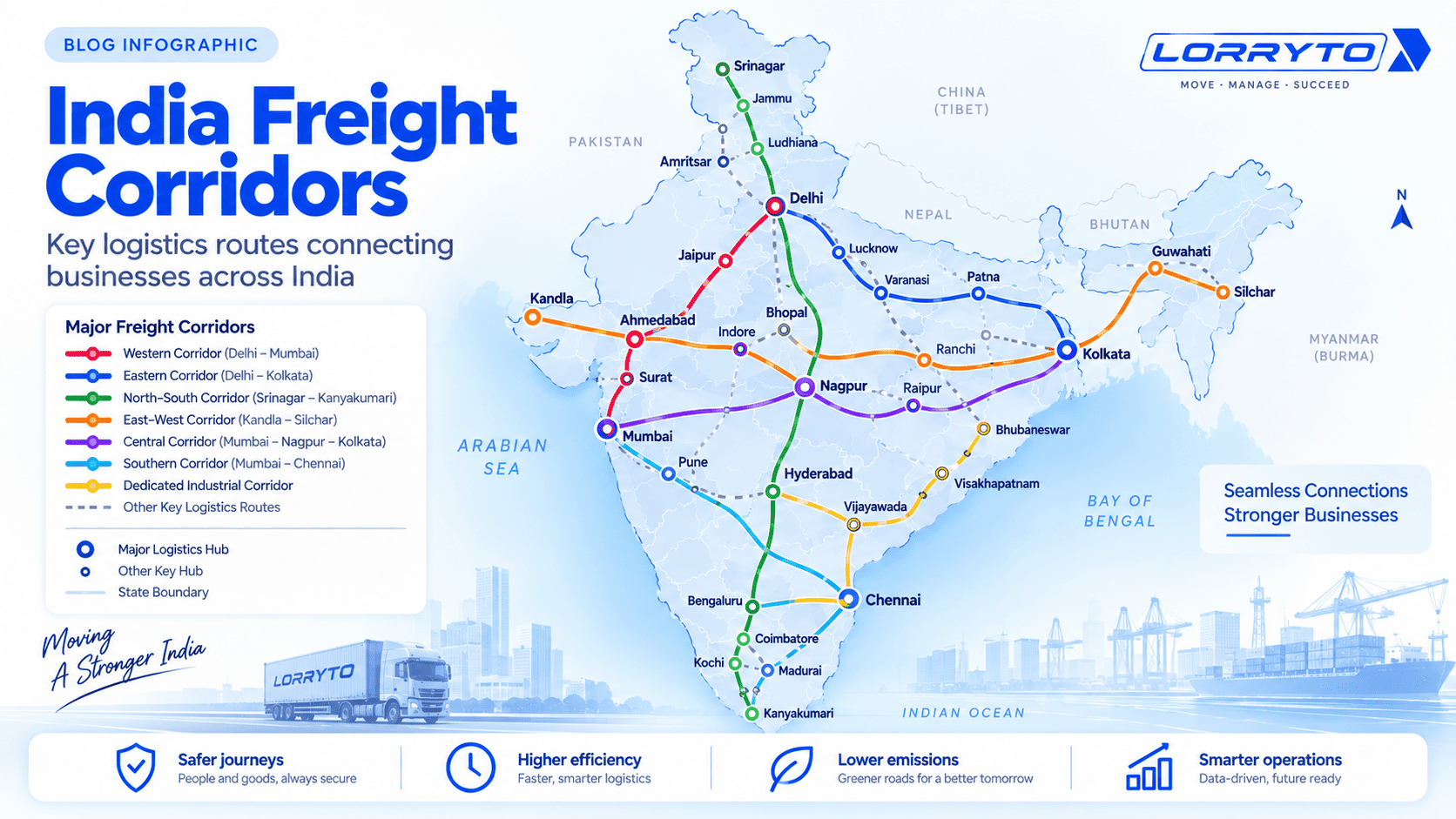
One of the most interesting developments in India’s electric trucking market is the move towards specific freight corridors rather than attempting to electrify every route at once.
In September 2026, Energy In Motion, Oil Field Warehouse & Services and Radiance Green Mobility announced plans to deploy 500 electric heavy commercial vehicles across major freight corridors in India.
The first 50 trucks are planned for the Mumbai–Pune route in October 2026, with the wider deployment covering routes including Mumbai–Pune, Mundra–Morbi–Ahmedabad and Mumbai–Delhi. The programme is being supported by charging and battery-swapping infrastructure.
This corridor-led approach makes practical sense.
Freight corridors have predictable cargo movement, established industrial activity and regular demand between ports, manufacturing centres, warehouses and markets.
Instead of asking an electric truck to operate anywhere in the country, operators can initially focus on routes where vehicle utilisation is high and energy infrastructure can be planned around actual freight demand.
That makes electrification easier to manage.
The truck is no longer being treated only as an experiment.
It becomes part of a planned freight network.
The real innovation may be the infrastructure around the truck
Electric trucks naturally receive most of the attention.
But the bigger challenge may actually be everything that supports them.
A diesel truck can refuel at a large network of fuel stations. Heavy electric trucks need access to suitable charging or battery-swapping infrastructure at the right locations.
For a commercial vehicle, this is critical.
Imagine a truck travelling on a fixed freight route. If it reaches a planned charging point and the charger is unavailable, the problem is not simply about electricity.
It becomes a logistics problem.
The truck may have to wait.
The delivery could be delayed.
The next trip may be affected.
Vehicle utilisation can fall.
And the transporter may lose revenue.
This is why the success of electric freight will depend on infrastructure availability as much as vehicle technology.
The recent launch of PACT reflects this challenge. The platform is designed to aggregate freight demand and help connect shippers, logistics providers, vehicle manufacturers, financiers and charge-point operators so that electric freight corridors can be planned around actual commercial demand.
Battery swapping could change the equation
Charging is not the only solution being explored.
Battery swapping is becoming an important part of India’s heavy electric freight discussion because it can potentially reduce the amount of time a commercial vehicle spends waiting for energy.
Instead of keeping a truck parked while its battery charges, the depleted battery can be replaced with a charged one.
For a private car, charging time may simply be an inconvenience.
For a commercial truck, it can affect the economics of the entire operation.
A truck that spends less time waiting can potentially complete more productive kilometres.
The 500-truck freight deployment announced by Energy In Motion and its partners is particularly interesting because it combines electric heavy vehicles with battery-swapping and charging infrastructure.
This shows an important change in thinking.
The question is no longer just:
“How do we build an electric truck?”
It is becoming:
“How do we keep an electric truck working throughout the day?”
That is a much more important question for transporters.
Uptime will decide whether electric freight works
Transport businesses make money when their vehicles are moving.
A truck sitting idle is not generating revenue.
This makes uptime one of the most important factors in the electric freight business.
An electric truck may have lower energy and maintenance costs in certain applications, but those advantages matter only when the vehicle is being used productively.
Transporters will therefore need to look closely at:
- Charging time
- Battery-swapping availability
- Route distance
- Daily kilometres
- Loading and unloading time
- Waiting time
- Vehicle utilisation
- Energy consumption
- Trip frequency
This means fleet planning will become increasingly data-driven.
Instead of simply asking whether an electric truck has enough range, fleet managers will need to understand whether the entire trip cycle works.
Major truck manufacturers are already moving into heavy electric freight
The transition is not limited to startups and pilot projects.
Major commercial vehicle manufacturers are also moving into heavy electric freight.
In April 2026, Tata Motors began deliveries of its Prima E.55S electric prime movers to BillionE Mobility and announced an additional order for 250 vehicles.
The trucks are planned for deployment across freight corridors in Gujarat, Rajasthan, Tamil Nadu, Karnataka, Maharashtra, Delhi NCR and Haryana, supporting the movement of steel, cement and other industrial goods.
The Prima E.55S is designed specifically for demanding freight operations and comes with a 450 kWh battery pack. Tata Motors says the vehicle has a range of up to 350 km on a single charge and is designed around factors such as uptime, energy efficiency and total cost of ownership.
This is significant because it shows that electric trucking is expanding beyond smaller commercial vehicles and entering heavy-duty, inter-city freight applications.
The economics matter more than the technology
For transporters, buying a new truck is a business decision.
It is not enough for an electric truck to be technologically impressive.
It needs to make financial sense.
Several factors will determine whether it does.
1. Initial vehicle cost
Electric trucks can require a higher upfront investment than conventional diesel vehicles.
That makes financing, leasing and alternative ownership models important.
At the 2026 e-FAST India Summit, NITI Aayog highlighted blended finance mechanisms, leasing models and stronger data systems as ways to help bring the cost of capital for electric trucks closer to diesel equivalents.
2. Energy cost
Electricity can provide an operating-cost advantage in suitable applications, but the actual economics depend on factors such as electricity prices, charging infrastructure, energy consumption, battery performance and route characteristics.
Transporters therefore need to look at the actual cost per trip, not just the cost per unit of electricity.
3. Vehicle utilisation
An electric truck that spends too much time waiting to charge may not deliver the expected financial benefit.
High utilisation will be critical.
4. Battery and maintenance costs
Battery health, degradation, maintenance and replacement costs will all affect the long-term economics of electric trucks.
5. Route suitability
Not every route will be ready for electrification at the same time.
Routes with predictable distances, regular freight demand and suitable energy infrastructure may be among the first to make commercial sense.
This is another reason corridor-based deployment is important.
Electric freight will need better data
There is another part of the transition that is easy to overlook.
Electric trucks will depend heavily on operational data.
Transporters will need to understand:
- How much energy each vehicle uses
- Which routes consume more energy
- How often vehicles need charging
- How long vehicles remain idle
- Which vehicles are being utilised efficiently
- How much each trip costs
- How revenue compares with operating expenses
- Whether an electric truck is performing better than a comparable diesel vehicle
This makes digital fleet management increasingly important.
A transporter cannot make good electrification decisions if vehicle, trip and expense information is scattered across notebooks, spreadsheets, WhatsApp messages and separate systems.
This is where fleet-management platforms can play a supporting role.
For example, platforms such as Lorryto already help transport businesses bring important fleet information into one place — including live vehicle location when drivers share GPS, trip information and vehicle-level revenue and expense tracking on the Vehicles list.
The role of software is not necessarily to control the electric vehicle itself.
It is to give the transport business better visibility into how the vehicle and its trips are performing — the same foundation that matters as fleets become more digitally tracked and, over time, more intelligent.
The rise of the data-driven transporter
Electric trucks may change more than the vehicles sitting in a transporter’s yard.
They may change how transport businesses make decisions.
Traditional fleet management often relies heavily on experience.
A fleet manager knows which vehicle performs well.
The driver knows which route normally causes delays.
The operator knows where fuel is easily available.
Over time, this knowledge becomes part of the business.
Electric fleets introduce more variables.
The transporter needs to know:
Which route is most efficient?
Where should the vehicle recharge?
How much energy will the trip require?
How much did the trip actually cost?
How much time was the vehicle productive?
Is the vehicle generating the expected return?
The more accurate the data, the easier it becomes to answer these questions.
What about small and mid-sized transporters?
Large logistics companies may have the capital and infrastructure partnerships needed to experiment with electric trucks.
But India’s freight industry is also made up of thousands of small and mid-sized transport operators.
For them, the transition will probably happen gradually.
A transporter may not replace an entire fleet with electric vehicles.
Instead, they may start with one or two trucks on predictable routes.
If those vehicles deliver good uptime, acceptable operating costs and reliable turnaround times, the transporter can gradually expand the electric fleet.
This approach allows businesses to collect real operational data before making larger investments.
The future may therefore not be about simply choosing diesel or electric.
It may be about choosing the right vehicle for the right route.
Ports and industrial routes could become early use cases
Some of India’s most promising applications for electric heavy vehicles may be locations where freight movement is already relatively structured.
Ports are one example.
Industrial corridors are another.
A truck repeatedly travelling between a factory, warehouse, distribution centre or port has a more predictable operating pattern than a vehicle constantly travelling across different routes.
That makes it easier to plan charging infrastructure, monitor vehicle performance and measure the economics of electrification.
The experience gained from these operations can then help companies expand electric freight to more complex routes — a gradual-build pattern similar to how other transport technologies are moving from controlled environments into broader networks, as we discussed with autonomous freight.
The biggest challenge is not the truck
It is easy to think that the biggest challenge is developing a better electric truck.
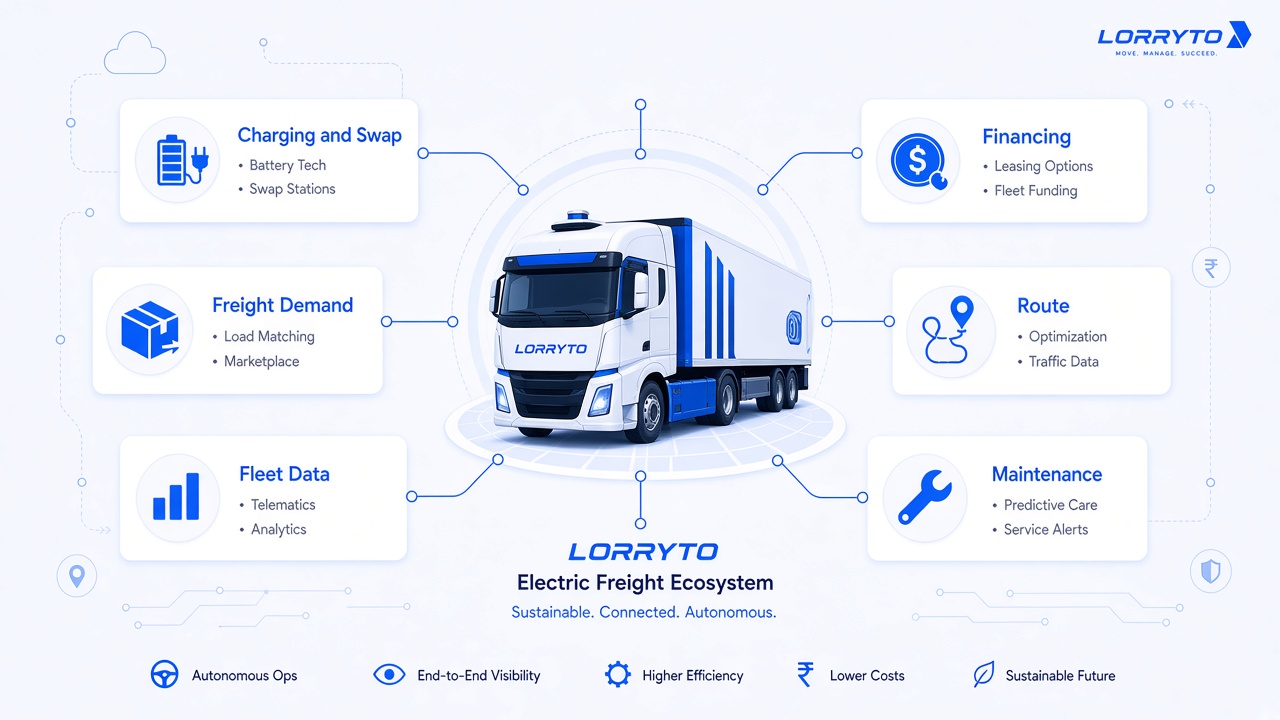
But the bigger challenge is building the ecosystem around it.
That ecosystem includes:
- Electric trucks
- Charging and battery swapping
- Financing
- Freight demand
- Reliable routes
- Fleet management
- Data
- Maintenance and support
If one of these pieces is missing, large-scale adoption becomes more difficult.
This is why the September 2026 launch of PACT and the ZET Marketplace is important.
The initiative is intended to bring different parts of the freight ecosystem together and create stronger commercial conditions for zero-emission trucking.
The lesson is simple:
You cannot build an electric freight network by selling electric trucks alone.
Will electric trucks replace diesel trucks?
Not immediately.
Diesel trucks will remain an important part of India’s freight network for years.
India already has a large diesel fleet, an established fuel network and a transportation system built around conventional vehicles.
Electric trucks also have challenges that still need to be solved before they can work economically on every route.
But that does not make the transition insignificant.
The more realistic scenario is gradual adoption.
Electric trucks will first gain ground where the economics and infrastructure make sense.
High-utilisation freight corridors may be among the first.
Ports and industrial routes may follow.
Urban and regional freight may see faster adoption in selected applications.
As technology improves and infrastructure expands, the range of suitable applications can increase.
India’s electric freight future will be corridor by corridor
The most important thing to understand about India’s electric trucking transition is that it probably will not happen through one massive nationwide switch.
It will happen corridor by corridor.
A route will demonstrate that the economics work.
Infrastructure will be developed around it.
More vehicles will be deployed.
More freight will move through the corridor.
The operational data will improve future deployments.
Then another corridor will follow.
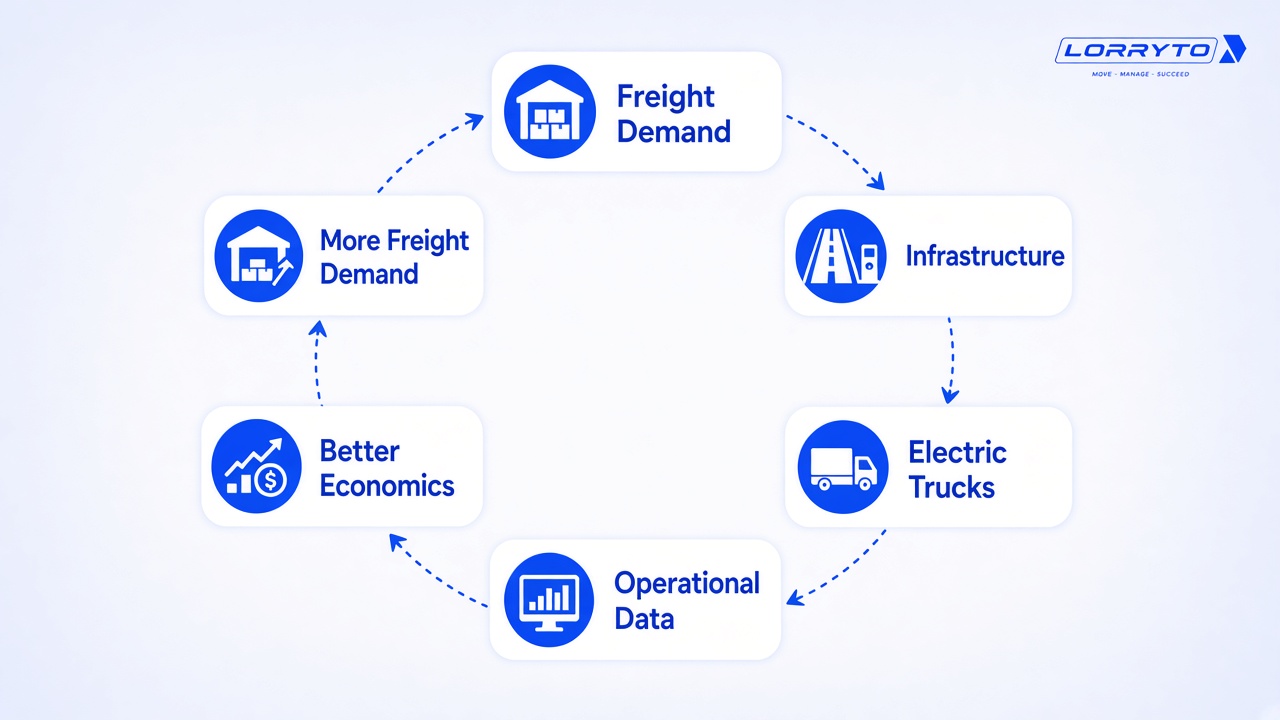
The cycle could look like this:
Freight Demand → Infrastructure → Electric Trucks → Operational Data → Better Economics → More Freight Demand
If that cycle works, today’s early deployments could gradually become a much larger electric freight network.
What should transporters start thinking about today?
Transporters do not necessarily need to purchase an electric truck immediately.
But they should start understanding where electrification could fit into their business.
A good starting point is to study the existing fleet.
Look at:
- Frequently used routes
- Average kilometres per trip
- Vehicle utilisation
- Fuel expenditure
- Maintenance costs
- Loading patterns
- Waiting time
- Daily trip frequency
- Customer delivery requirements
- Availability of charging or swapping infrastructure
This information can help identify which routes may be suitable for electric vehicles.
The transition should be based on operational numbers, not simply on excitement around new technology.
Better location and trip visibility and cleaner expense records make those comparisons far easier when the right electric opportunity appears.
The road ahead
India’s electric freight journey is entering a new phase.
The country is no longer discussing only whether electric trucks are technically possible.
The conversation is increasingly about where they can work, how they can be financed, how they can be charged and whether they can make commercial sense.
The launch of PACT and the Zero Emission Truck Marketplace, the planned deployment of 500 electric heavy vehicles across major freight corridors, and the growing deployment of heavy electric trucks by established manufacturers all point towards the same direction.
But the success of electric freight will not be decided by the truck alone.
It will be decided by the entire system around it.
For transporters, the next few years could therefore be less about asking:
“Should we move to electric?”
and more about asking:
“Which part of our fleet is ready for electric?”
“Which routes make the most sense?”
“What infrastructure do we need?”
And perhaps most importantly:
“Do we have enough operational data to make the right decision?”
Electric trucks may have started as pilot projects.
Now, they are beginning to become part of India’s real freight network.
The next stage is not simply about putting more electric trucks on the road.
It is about building the infrastructure, data systems and business models that can make electric freight commercially sustainable.
And if that ecosystem continues to develop, India’s highways could look very different over the next decade.
If you are still building that operational data foundation — trips, vehicles, costs and locations in one place — getting started with Lorryto is a practical place to begin.
Related reading
- The Driverless Truck Is No Longer a Future Idea: How Autonomous Freight Is Moving Into Real-World Operations
- The Intelligent Truck Is Here: How AI Is Changing the Way Trucks Work
- Google Maps Isn’t Enough for Indian Logistics. Here’s Why AI Maps Matter
- How to Manage Every Trip Tracking Digitally for Indian Transporters
- Vehicles list — location, KPIs, and fleet visibility
Ready to run trips without registers?
Create LRs, track payments, and keep documents in one place with Lorryto — free trial available.
Start Free Now